Vimshottari dasa: balance at birth and your current period
Updated October 12, 2026 · 7 min read · 6 sections
One arc-minute of the Moon moves a Saturn dasa by about nine days. That is why the Vimshottari dasa balance, the part of the first dasa still left at birth, is the number in a jathakam most sensitive to a small slip in time, place or ayanamsa. It is also plain arithmetic you can do on paper in five lines, and the steps below do it on a real chart from the jathakam chart calculator.
The 120-year cycle and who rules which nakshatra
Vimshottari gives nine planets a fixed number of years that add up to 120, always in the same order (the standard description lists them the same way). Each planet rules three nakshatras, nine apart, so a nakshatra's lord repeats every ninth star.
| Lord | Years | Nakshatras |
|---|---|---|
| Ketu | 7 | Ashwini (Aswathi), Magha (Makam), Mula (Moolam) |
| Venus | 20 | Bharani, Purva Phalguni (Pooram), Purva Ashadha (Pooradam) |
| Sun | 6 | Krittika (Karthika), Uttara Phalguni (Uthram), Uttara Ashadha (Uthradam) |
| Moon | 10 | Rohini, Hasta (Atham), Shravana (Thiruvonam) |
| Mars | 7 | Mrigashira (Makayiram), Chitra (Chithira), Dhanishta (Avittam) |
| Rahu | 18 | Ardra (Thiruvathira), Swati (Chothi), Shatabhisha (Chathayam) |
| Jupiter | 16 | Punarvasu (Punartham), Vishakha (Vishakham), Purva Bhadrapada (Pooruruttathi) |
| Saturn | 19 | Pushya (Pooyam), Anuradha (Anizham), Uttara Bhadrapada (Uthrattathi) |
| Mercury | 17 | Ashlesha (Ayilyam), Jyeshtha (Thrikketta), Revati (Revathi) |
To find the lord from the nakshatra number n (Ashwini = 1), take (n − 1) mod 9 and read down the table from Ketu = 0. Pushya is number 8, 7 mod 9 = 7, which is Saturn.
The balance at birth, step by step
The first dasa is that of the lord of the Moon's nakshatra, but you are born somewhere inside it, never at its start. The balance is the part still ahead. The worked case is the Chennai chart: Moon at Cancer 10°51', sidereal longitude 100.859°.
- Nakshatra. 100.859° ÷ 13.333° = 7.56, so the Moon is in the 8th nakshatra, Pushya, ruled by Saturn (19 years).
- Where Pushya starts. 7 × 13.333° = 93.333°, which is Cancer 3°20'.
- Passed and ahead. 100.859° − 93.333° = 7.526° passed; 13.333° − 7.526° = 5.807° still ahead.
- Fraction left. 5.807° ÷ 13.333° = 0.43555.
- Balance. 0.43555 × 19 years = 8.2755 years of Saturn dasa remain.
- Years, months, days. 8 full years; 0.2755 × 12 = 3.31 months, so 3 months; 0.31 × 30.4375 days = 9.3 days. Balance: 8 years, 3 months, 9 days, each part rounded down, which is how the calculator prints it (8 y 3 m 9 d). That is the sishta dasa.
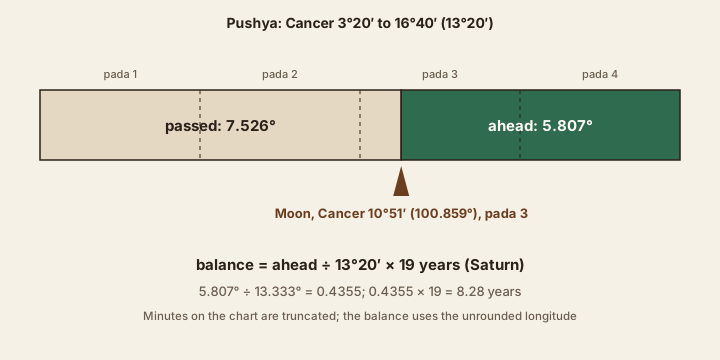
Two checks I always do. A Moon exactly halfway through a nakshatra leaves half the years: at 100° (Cancer 10°00', 6°40' ahead in Pushya) the balance is 9.5 years, which is 9 years 6 months. And the balance can never exceed the lord's full years or fall below zero. If a program prints 22 years of Saturn, something is wrong.
From the balance to all nine mahadasas
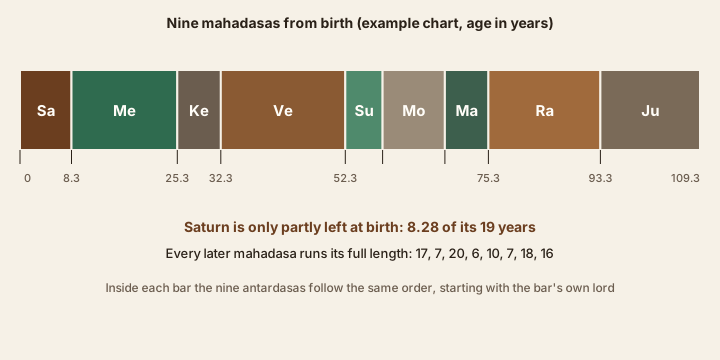
After the balance, each following lord runs a full period in the order of the cycle. For the example chart, counted from birth with a 365.25-day year, as local dates in the birth time zone:
| Mahadasa | Years | Starts at age | Ends on |
|---|---|---|---|
| Saturn (balance) | 8.28 | 0 | 23-11-1993 |
| Mercury | 17 | 8.28 | 24-11-2010 |
| Ketu | 7 | 25.28 | 23-11-2017 |
| Venus | 20 | 32.28 | 23-11-2037 |
| Sun | 6 | 52.28 | 24-11-2043 |
| Moon | 10 | 58.28 | 23-11-2053 |
| Mars | 7 | 68.28 | 23-11-2060 |
| Rahu | 18 | 75.28 | 24-11-2078 |
| Jupiter | 16 | 93.28 | 24-11-2094 |
Antardasa, or apaharam
Each mahadasa is divided among all nine planets in the same order, starting with its own lord. The length of a sub-period is:
Take the Jupiter mahadasa of a chart drawn for Kochi at noon, where the Moon in Swati leaves a Rahu balance of 4.44 years and Jupiter therefore starts on 11-06-2004. Jupiter's own sub-period is 16 × 16 ÷ 120 = 2.133 years; Saturn's is 16 × 19 ÷ 120 = 2.533 years.
| Antardasa | Years | Ends on |
|---|---|---|
| Jupiter–Jupiter | 2.133 | 31-07-2006 |
| Jupiter–Saturn | 2.533 | 10-02-2009 |
| Jupiter–Mercury | 2.267 | 19-05-2011 |
| Jupiter–Ketu | 0.933 | 24-04-2012 |
| Jupiter–Venus | 2.667 | 24-12-2014 |
| Jupiter–Sun | 0.8 | 12-10-2015 |
| Jupiter–Moon | 1.333 | 10-02-2017 |
| Jupiter–Mars | 0.933 | 17-01-2018 |
| Jupiter–Rahu | 2.4 | 11-06-2020 |
The nine lengths add up to 16 years, the whole mahadasa, which is a quick check on any table you build. The first mahadasa is a special case: you are born inside one of its antardasas. In the Chennai chart the Saturn antardasas end at 3.008, 5.700, 6.808, 9.975 and 10.925 years from the start of the mahadasa, and 19 − 8.2755 = 10.7245 years had already passed at birth, so the child is born in Saturn–Sun with about 73 days of it left. The calculator lists all nine Saturn apaharams counted from the start of the full 19 years and marks the four that ended before birth.
Finding the period running on a given day
- List the mahadasas with their end dates, as in the table above.
- Pick the row whose start is on or before your day and whose end is after it.
- Build that mahadasa's antardasa table with the formula, starting at the mahadasa's start date.
- Pick the antardasa row in the same way. The pair, for example Ketu–Jupiter, is the period running.
As an example, take the day the example person turns 30, 15-08-2015. It falls in the Ketu mahadasa (24-11-2010 to 23-11-2017), whose antardasas are:
| Antardasa | Years | From | To |
|---|---|---|---|
| Ketu–Ketu | 0.408 | 24-11-2010 | 22-04-2011 |
| Ketu–Venus | 1.167 | 22-04-2011 | 21-06-2012 |
| Ketu–Sun | 0.35 | 21-06-2012 | 27-10-2012 |
| Ketu–Moon | 0.583 | 27-10-2012 | 28-05-2013 |
| Ketu–Mars | 0.408 | 28-05-2013 | 24-10-2013 |
| Ketu–Rahu | 1.05 | 24-10-2013 | 11-11-2014 |
| Ketu–Jupiter | 0.933 | 11-11-2014 | 18-10-2015 |
| Ketu–Saturn | 1.108 | 18-10-2015 | 26-11-2016 |
| Ketu–Mercury | 0.992 | 26-11-2016 | 23-11-2017 |
15-08-2015 lies between 11-11-2014 and 18-10-2015, so the running period is Ketu–Jupiter. The calculator highlights the mahadasa and apaharam running today for you (a tap on a mahadasa opens its apaharams), but it is worth doing the lookup once by hand so the table stops being a black box.
Why two programs give different dates
Dasa dates move for reasons that are easy to measure. The key figure is how many days one arc-minute of the Moon is worth for each lord. Since 13°20' is 800 arc-minutes, the answer is the lord's years × 365.25 ÷ 800:
| Lord | Ketu | Venus | Sun | Moon | Mars | Rahu | Jupiter | Saturn | Mercury |
|---|---|---|---|---|---|---|---|---|---|
| Days | 3.2 | 9.1 | 2.7 | 4.6 | 3.2 | 8.2 | 7.3 | 8.7 | 7.8 |
The Moon travels about 33 arc-minutes in an hour on average. With that, the usual causes can be sized:
| Cause | Moon shift | Effect on the dates |
|---|---|---|
| Time zone or summer time wrong by one hour | about 33' | roughly 90 to 300 days, depending on the lord |
| Birth time off by ten minutes | about 5' | roughly 15 to 45 days |
| Lahiri against Raman ayanamsa | about 1°27' | from about 8 months to over two years, and sometimes a different first lord |
| Lahiri against KP ayanamsa | about 6' | roughly 15 to 55 days |
| A 360-day year instead of 365.25 | none | nearly 100 days across a 19-year Saturn period |
The year length is a matter of convention: the usual description uses the solar year of 365.25 days, which the calculator follows. A difference of a single day between two programs that otherwise agree usually comes from the hour of day at which the balance is counted from, or from turning decimal years into months at 30 days instead of 30.4375. The calculator shows local dates in the birth time zone, so a program that prints UTC dates can differ by one day; the Jupiter–Jupiter end date is 31-07-2006 in India and 30-07-2006 in UTC.
When you compare with a printed jathakam, first make sure both use the same ayanamsa, then check the time zone: India's war-time offset and summer time abroad are the two silent culprits. The chart format never changes the dasa, and the navamsa is calculated from the same positions without affecting it.
Dasa periods are calculated for traditional use. They are not a prediction and not advice.
Frequently asked
How is the dasa balance at birth calculated?
Find the Moon's nakshatra, take the part of it still ahead of the Moon as a fraction of 13°20', and multiply by that nakshatra lord's dasa years. A Moon halfway through Pushya leaves half of Saturn's 19 years, which is 9.5 years.
Which dasa am I running now?
List your mahadasas with their end dates and pick the one that includes today. Then split it into antardasas with mahadasa years × sub-lord years ÷ 120 and pick the one that includes today.
Why is my first dasa shorter than the lord's full years?
You were born part-way through the Moon's nakshatra, so only the balance remains. Every dasa after the first runs for its full length.
Why does another website show different dasa dates?
The usual reasons are a different ayanamsa, a wrong time zone, a slightly different birth time or a 360-day year instead of 365.25 days. Compare these four before anything else.
What is sishta dasa?
It is the balance of the first dasa at birth, usually written in years, months and days.