Rasi chart and navamsa chart: what the D9 adds to your jathakam
Updated October 12, 2026 · 7 min read · 6 sections
Your lagna is Leo and your Moon is in Cancer, yet the second square on the same jathakam sheet shows Taurus and Libra. Nothing is wrong. The first square is the rasi chart; the second is the navamsa chart, the D9, and it is the rasi chart looked at nine times closer. Below, each planet is moved from one chart to the other step by step, with every number checked against the example chart from the jathakam chart calculator.
Each sign cut into nine parts
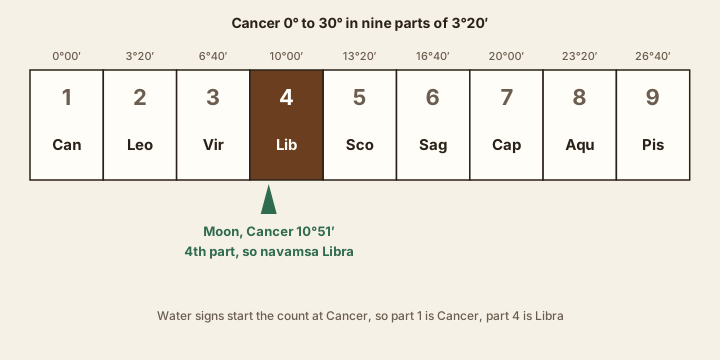
A sign is 30° wide. The navamsa divides it into nine equal parts of 3°20' each, and every part is given a sign of its own. A planet is placed in the navamsa sign of the part it occupies. So a planet at Cancer 10°51' has two addresses: Cancer in the rasi chart, and the sign that part 4 of Cancer carries in the navamsa chart.
Three degrees twenty minutes is also exactly the width of a pada, the quarter of a nakshatra (27 nakshatras of 13°20', each in four padas). Twelve signs times nine parts, or 27 nakshatras times four padas, both give 108 slices, and they are the same slices. That gives a shortcut: number the nakshatras 1 to 27 and the padas 1 to 4, and the navamsa sign counted from Aries (Aries = 0) is (4 × (nakshatra number − 1) + pada − 1) mod 12. The example Moon is in Pushya (8), pada 3: 4 × 7 + 2 = 30, and 30 mod 12 = 6, which is Libra.
Where the count starts
The nine parts of a sign do not all start from Aries. The first part takes the sign that begins the same element, and the rest follow in zodiac order.
| Element | Signs | Part 1 is | Part 9 is |
|---|---|---|---|
| Fire | Aries, Leo, Sagittarius | Aries | Sagittarius |
| Earth | Taurus, Virgo, Capricorn | Capricorn | Virgo |
| Air | Gemini, Libra, Aquarius | Libra | Gemini |
| Water | Cancer, Scorpio, Pisces | Cancer | Pisces |
If you prefer a formula, take the sidereal longitude L in degrees from 0° Aries, multiply by 9, divide by 30, drop the fraction, and keep the remainder after dividing by 12. The result counts signs from Aries: 0 Aries, 1 Taurus, up to 11 Pisces. For the Moon, L = 100.859°, so 100.859 × 9 ÷ 30 = 30.26, which becomes 30, and 30 mod 12 = 6: Libra again. The table and the formula must agree, and they do.
Worked conversions, planet by planet
Three by hand first. In each case divide the degrees within the sign by 3°20' (3.333°), round up to get the part, then count from the starting sign.
- Moon, Cancer 10°51'. 10.85 ÷ 3.333 = 3.26, so part 4. Cancer is water and counts from Cancer: Cancer, Leo, Virgo, Libra.
- Lagna, Leo 5°38'. 5.63 ÷ 3.333 = 1.69, so part 2. Leo is fire and counts from Aries: Aries, Taurus.
- Venus, Gemini 20°56'. 20.93 ÷ 3.333 = 6.28, so part 7. Gemini is air and counts from Libra: Libra, Scorpio, Sagittarius, Capricorn, Aquarius, Pisces, Aries.
The whole chart, with the same method:
| Point | Rasi position | Part | Navamsa |
|---|---|---|---|
| Lagna | Leo 5°38' | 2 | Taurus |
| Sun | Cancer 28°30' | 9 | Pisces |
| Moon | Cancer 10°51' | 4 | Libra |
| Mercury (R) | Cancer 21°31' | 7 | Capricorn |
| Venus | Gemini 20°56' | 7 | Aries |
| Mars | Cancer 19°46' | 6 | Sagittarius |
| Jupiter (R) | Capricorn 17°03' | 6 | Gemini |
| Saturn | Libra 28°07' | 9 | Gemini |
| Rahu | Aries 19°31' | 6 | Virgo |
| Ketu | Libra 19°31' | 6 | Pisces |
The navamsa lagna is the sign of the lagna's own navamsa, here Taurus, and the houses of the D9 are counted from it exactly as in the rasi chart, in whichever South or North Indian style you draw it. The calculator does this conversion for every point and shows the result both as the second chart and in the Navamsa column of the planet table. In the D9 above, Sun and Ketu share Pisces and Jupiter and Saturn share Gemini.
Vargottama: the same sign in both charts
When a planet's rasi sign and navamsa sign are the same, the planet is called vargottama. It happens only in one fixed slice of each sign type:
| Sign type | Signs | Degrees in the sign |
|---|---|---|
| Movable | Aries, Cancer, Libra, Capricorn | 0°00' to 3°20' |
| Fixed | Taurus, Leo, Scorpio, Aquarius | 13°20' to 16°40' |
| Dual | Gemini, Virgo, Sagittarius, Pisces | 26°40' to 30°00' |
No planet in the Chennai example qualifies; the calculator marks a vargottama planet with a badge in the planet table. In a chart drawn for Kochi at noon, Jupiter at Aries 1°28' does: Aries is movable, 1°28' is inside the first 3°20', and the D9 sign is Aries again. Traditional texts treat a vargottama planet as steady and well placed; I treat it as a useful marker that the two charts agree, not as a promise of anything.
Why the navamsa needs an accurate birth time
The rasi lagna stays in one sign for roughly two hours. The navamsa lagna changes nine times in that span, so each part lasts only 13 or 14 minutes. For the Chennai example on the day of birth, the lagna is in Leo from 06:06 to 08:09 local time:
| Part | Leo degrees | Navamsa lagna | From | To |
|---|---|---|---|---|
| 1 | 0°00' to 3°20' | Aries | 06:06 | 06:20 |
| 2 | 3°20' to 6°40' | Taurus | 06:20 | 06:34 |
| 3 | 6°40' to 10°00' | Gemini | 06:34 | 06:48 |
| 4 | 10°00' to 13°20' | Cancer | 06:48 | 07:02 |
| 5 | 13°20' to 16°40' | Leo | 07:02 | 07:15 |
| 6 to 9 | 16°40' to 30°00' | Virgo, Libra, Scorpio, Sagittarius | 07:15 | 08:09 |
A birth recorded at 06:30 is Taurus in the D9. Write 06:35 by mistake and it becomes Gemini. The hospital slip rounded to the nearest five minutes is the usual culprit, and so is a clock that ran fast.
The planets can be just as touchy. In the Kochi chart the Moon is at Libra 16°42', only two arc-minutes past the boundary at 16°40'. The Moon covers about half an arc-minute per minute of time, so a birth about five minutes earlier would put it at the end of part 5, and its navamsa would be Aquarius instead of Pisces. My working rule: if the birth time is uncertain by more than ten minutes, trust the rasi chart and treat the navamsa lagna and any planet within a few arc-minutes of a part boundary as provisional. If there is no birth time at all, the calculator shows the Moon chart only and does not invent a lagna.
How the two charts are read together
Astrologers read the rasi chart first, for the lagna, the houses and where each planet stands. The navamsa is then consulted for the planet itself: which sign it falls in there, and whether that sign is its own, a friend's or an unfriendly one. Many practitioners also look at the D9 lagna and the placement of the lord of the partnership house in partnership questions. These are conventions of the tradition and schools differ in how far they take them. The calculator does the arithmetic; the interpretation remains with the reader.
For the timing side of a chart, the Vimshottari dasa balance and the running period are worked out from the same Moon degree you used in the table above, without the navamsa.
These are calculated positions for traditional use, not a prediction and not advice.
Frequently asked
What is the navamsa chart in a jathakam?
It is the D9 divisional chart. Each sign is split into nine parts of 3°20', and every planet and the lagna is placed in the sign assigned to the part it occupies.
How do I find my navamsa sign by hand?
Divide the degrees within your sign by 3°20' and round up to get the part from 1 to 9. Count that many signs starting from Aries for fire signs, Capricorn for earth, Libra for air and Cancer for water.
What does vargottama mean?
A planet is vargottama when its rasi sign and navamsa sign are the same. That happens in the first 3°20' of a movable sign, the 13°20' to 16°40' span of a fixed sign and the last 3°20' of a dual sign.
Why does my navamsa lagna differ between two websites?
The navamsa lagna changes about every 13 minutes. A small difference in birth time, time zone or lagna calculation is enough to move it to a neighbouring sign.
Is the navamsa the same as the nakshatra pada?
They use the same 3°20' slices. A navamsa part gives a sign, while a pada is a quarter of a nakshatra; the navamsa sign follows from the nakshatra number and the pada.