South Indian vs North Indian chart: how to read both jathakam formats
Updated October 12, 2026 · 7 min read · 6 sections
Put a family jathakam beside a printout from the jathakam chart calculator and they look like two different documents: one is a grid of boxes, the other a diamond cut into twelve pieces. Both show the same twelve signs and nine planets. What differs is the thing the drawing keeps fixed, and once you know that, you can read either one and redraw it as the other in a couple of minutes.
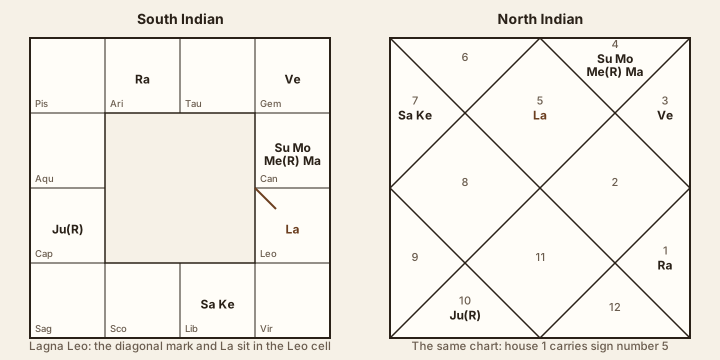
Every chart below is the same example, an early-morning birth in Chennai with lagna Leo 5°38' and the Moon in Cancer 10°51' (Pushya, pada 3). You can reproduce it in the calculator and switch between the two styles with one button; South Indian is the default and the calculator remembers your choice. The navamsa chart is drawn beside the rasi chart in the same style.
What stays fixed in each format
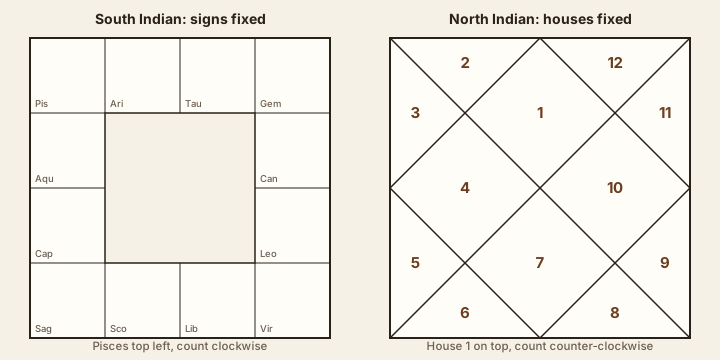
This single difference explains every other one, so learn it first. In the South Indian chart the signs have permanent cells and the lagna moves around. In the North Indian chart the houses have permanent places and the signs move around.
| Feature | South Indian | North Indian |
|---|---|---|
| Fixed | The twelve signs: Pisces top left, Aries to its right | The twelve houses: house 1 is the top central diamond |
| Lagna is found by | A diagonal slash or "La" in one cell | The sign number written in the top diamond |
| Counting direction | Clockwise | Counter-clockwise |
| Number in a cell | Usually none, or a sign name | The sign number, 1 for Aries to 12 for Pisces |
| Who draws it | Kerala and Tamil families almost always | Common across northern India and in many software exports |
Reading a South Indian chart in six steps
- Find the lagna cell. It carries a short diagonal line in one corner, or the letters La; the calculator draws both and writes the lagna degree after La, as in La 5°. The sign of that cell is the rising sign, the lagnam.
- Name the signs by position, not by what is written. Top row left to right: Pisces, Aries, Taurus, Gemini. Down the right side: Cancer, Leo. Along the bottom from right to left: Virgo, Libra, Scorpio, Sagittarius. Up the left side: Capricorn, Aquarius. In a Malayalam jathakam these are Meenam, Medam, Edavam, Mithunam, Karkidakam, Chingam, Kanni, Thulam, Vrischikam, Dhanu, Makaram, Kumbham.
- Count houses clockwise. The lagna cell is house 1, the next cell clockwise is house 2, and so on. Each cell is one whole-sign house, which is the practice for the rasi chart in Kerala and Tamil Nadu.
- Read the planets in each cell with the abbreviations below. A planet is in the sign of the cell, whatever its degree. In the calculator each entry also gives the degree within the sign, for example Ma 19° or Me 21°(R).
- Find the Moon. Its cell is the janma rasi. The birth star (naal) is not drawn on the chart; it comes from the Moon's exact degree in the planet table.
- Look for (R). It marks vakra, a retrograde planet. It does not mean Rahu.
| Mark | Meaning | Names you may meet in family papers |
|---|---|---|
| La | Lagna, the rising sign | Lagnam |
| Su, Mo | Sun, Moon | Ravi (Njayar), Chandran (Thinkal) |
| Ma, Me | Mars, Mercury | Kuja (Chovva), Budhan |
| Ju, Ve, Sa | Jupiter, Venus, Saturn | Guru (Vyazham), Shukran (Velli), Shani |
| Ra, Ke | Rahu, Ketu | Rahu, Ketu |
| (R) | Retrograde | Vakra |
Reading a North Indian chart
The diamond is easier once you stop looking for planets and look for the numbers.
- House 1 is always the top central diamond. The number written there is the sign of the lagna: 5 for Leo in our example.
- Houses run counter-clockwise. House 2 is the top-left triangle, 3 the upper-left triangle, 4 the left diamond, 5 and 6 the two lower-left triangles, 7 the bottom diamond, 8 and 9 the lower-right triangles, 10 the right diamond, 11 and 12 the upper-right triangles.
- The numbers are signs, not houses. 1 is Aries, 2 Taurus, up to 12 for Pisces. The sign in house h is the lagna number plus h minus 1, taking away 12 if the total passes 12.
- Planets sit in the cell of their sign. To find a planet's house, read which cell it is in, not the number beside it.
| House | Number in cell | Sign | Planets |
|---|---|---|---|
| 1 | 5 | Leo | Lagna |
| 2 | 6 | Virgo | none |
| 3 | 7 | Libra | Saturn, Ketu |
| 4, 5 | 8, 9 | Scorpio, Sagittarius | none |
| 6 | 10 | Capricorn | Jupiter (R) |
| 7, 8 | 11, 12 | Aquarius, Pisces | none |
| 9 | 1 | Aries | Rahu |
| 10 | 2 | Taurus | none |
| 11 | 3 | Gemini | Venus |
| 12 | 4 | Cancer | Sun, Moon, Mercury (R), Mars |
Redrawing one format as the other
South to North.
- Write the lagna sign number in the top diamond (Leo is 5).
- Go counter-clockwise and write the next sign numbers: 6, 7, 8 and so on, wrapping from 12 to 1.
- Copy each planet into the cell whose number is its sign.
North to South.
- Read the top number, find that sign's fixed cell in the grid, and put the diagonal mark and La there.
- For every other cell, the number tells you its sign; write the planets of that cell into the grid cell of the same sign.
Check the result with two quick tests: the Moon must be in the same sign in both drawings, and all nine planets must appear once. In the example, Saturn and Ketu sit in the third cell counter-clockwise from the top on the North chart, and in the second cell from the right on the bottom row of the South chart. Both are Libra.
There is also a third style, used in Bengal and Odisha, drawn as a three-by-three block with its corner boxes cut diagonally. If your family papers come from there, find the lagna mark first and then identify the signs from the cell labels before trusting any count. The calculator draws the two styles Kerala and Tamil families use most, for the rasi chart and for the navamsa chart.
Misreadings I see most often
- Taking North Indian numbers for houses. Jupiter in the example sits in the cell numbered 10, yet it is in the 6th house from the lagna. The 10 is Capricorn.
- Counting every chart clockwise. South Indian counting is clockwise; North Indian counting is counter-clockwise.
- Looking for Aries top left. That cell is Pisces. Aries is the second one.
- Reading the diagonal slash as a planet. It marks the lagna and nothing else.
- Reading (R) as Rahu. R is retrograde; Rahu is Ra.
- Mixing up the two squares on a printed sheet. The second one is usually the navamsa (amsam, D9), read in the same way but from a different calculation. Rasi chart and navamsa chart explains how it is made.
Which format should you use?
Use the one your family's existing jathakam uses, because the point of a new chart is usually to compare it with an old one. Both formats carry exactly the same information, and a calculator that gives you both lets you check one against the other. If you are matching two horoscopes, put them in the same style first; comparing a grid to a diamond by eye is how mistakes happen.
Once the lagna is clear, the next thing most people want is the running period: how the Vimshottari dasa balance and the current period are worked out. The chart format does not change that calculation, which depends only on the Moon's degree.
The positions shown by the calculator are astronomical calculations drawn for traditional use. They are not a prediction and not advice.
Frequently asked
Is the South Indian chart or the North Indian chart correct?
Both are correct. They draw the same signs and planets with a different fixed element: signs are fixed in the South Indian chart, houses in the North Indian one.
Why is there a number in each cell of my North Indian chart?
The number is the sign, counted from 1 for Aries to 12 for Pisces. The house is given by the position of the cell, with house 1 at the top.
How do I find my lagna in a South Indian chart?
Look for the cell with a diagonal slash in the corner or the letters La. That cell's sign is your rising sign, and it is house 1.
Where is Aries in a South Indian chart?
Aries is the second cell of the top row. The top-left cell is Pisces, and the signs continue clockwise from there.
Can I convert a South Indian chart to a North Indian one by hand?
Yes. Put the lagna sign number in the top diamond, continue counter-clockwise with the following sign numbers, and copy each planet into the cell carrying its sign number.